

Table of Contents
This is a response to a Facebook post that crossed my path, from an apparent uber-MAGA whiner, Bob, who one suspects is not a scholar at the Hoover Institute. Bob’s complaint (shared by Sabrina)? Evil Democrats criticize Trump’s alleged draft dodging while keeping mum about their own team’s record, a rationalization or tactic commonly known as “whataboutism.”
Perhaps he doesn’t hear Democrats talk about these things because he doesn’t know any, or possibly he gets his news in the media bubble that shelters his cherished beliefs from factual abrasion. Either way, and notwithstanding the old warning to avoid fighting with barnyard animals,* it did make me curious about Presidential candidates’ (both winners and losers) military service or its avoidance. And so I looked it up, all the way back to the post-war.
A few factoids. Since World War 2 ...
- Five Presidential candidates were pilots. Two were shot down in combat; another crash landed his crippled bomber on his way back from Germany.
- One was a member of Congress when he enlisted.
- Among WW2 veterans, four served in the Navy, all of them in the Pacific; three in Europe (two in the Army, one in the Army Air Corp); one stayed stateside; one was turned away but found other ways to serve. The Greatest Generation came through honorably and bravely.
- Four received Purple Hearts (one had two, another three).
- Two served during Korea, but only one was deployed there.
- Six were draft eligible during Vietnam, but only three wore the uniform or ever set foot in Vietnam. All three of them lost.
Now some details in order of election year.
- Dwight Eisenhower (wins in 1952 & ’56) commanded an Army of 4 million and won WW2. Any questions?
- Adlai Stevenson II (losing to Eisenhower twice) was 41 when the war broke out, already serving as a civilian in the Department of the Navy. Did his part, you’d have to say.
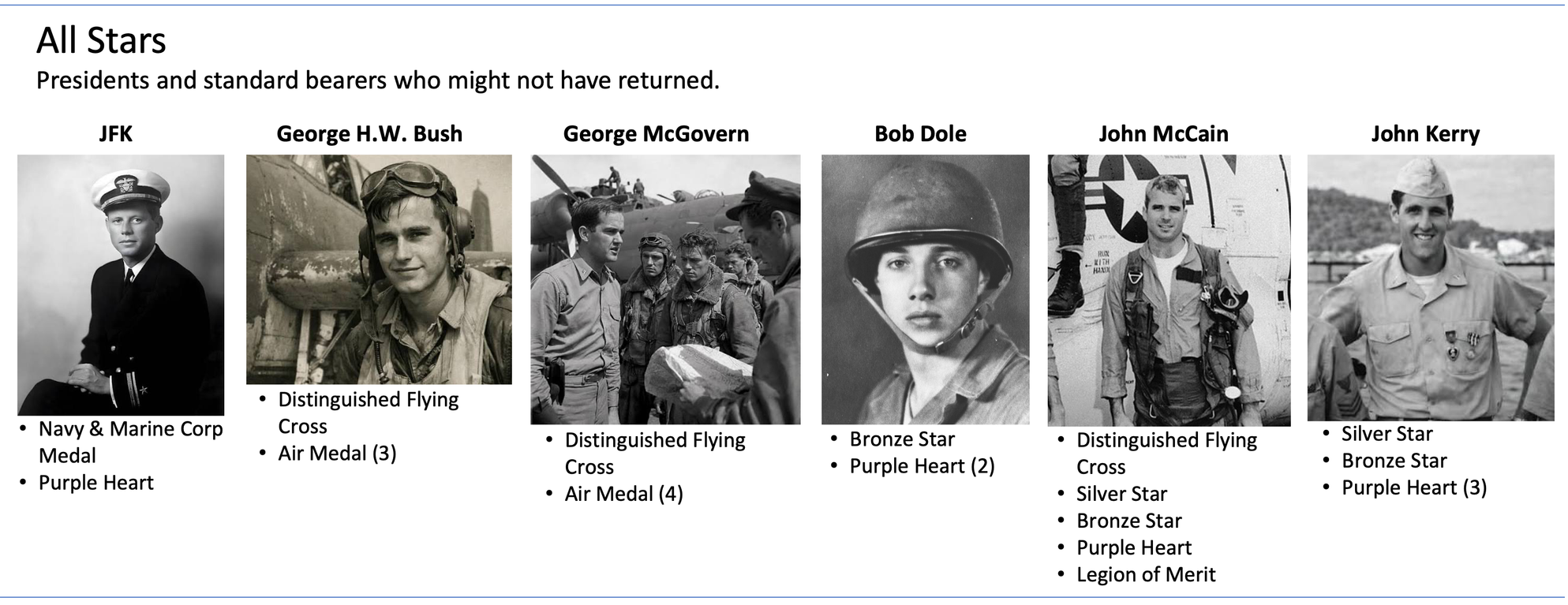
- John Kennedy (wins 1960) had his PT boat sliced in half by a Japanese destroyer in the middle of the night, then saved his crew, for which he was awarded the Navy and Marine Corp Medal and a Purple Heart. A back injury plagued him for the rest of his life.
- Lyndon Johnson (assumes the Presidency in 1963, wins in 1964) was a Congressman when the war started. Nevertheless, he enlisted and served six months in the Pacific. He volunteered for one mission and had the extraordinary luck to switch planes before takeoff because, and this is true, he needed to use the toilet. The plane he was supposed to board was shot down, while the one he actually flew on turned around due to mechanical problems. Although they never reached their target, he and the crew all received Silver Stars for their aborted flight.
- Barry Goldwater (looses to Johnson in 1964) had an extraordinary military career that began in WW2 as a pilot in the Army Air Corp, and concluding in 1967 as a Major General in the Arizona National Guard. In the war he flew in both theaters, first piloting P-47 fighters across the Atlantic, then flying transports over the “hump,” a treacherous flight from India, over Burma and the Himalayas, and into China. Later he would have enough courage to tell a President that he would vote to convict him in an impeachment trial.
- Richard Nixon (loses in 1960, wins in 1968 and ’72) was not in combat directly but was close to it as a Navy logistics officer in the South Pacific. Often at forward positions in the Solomon Islands (Guadalcanal. Yikes!) and Bougainville, his unit was frequently bombed and under threat throughout his enlistment. He served honorably. One wishes he had been equal honorable as President.
- Hubert Humphrey (loses to Nixon 1968) attempted to enlist three times, but kept coming up 4-F due multiple health issues. He pivoted towards work supporting wartime production and labor, eventually rising to Assistant Director of the Wartime Manpower Commission, created by Roosevelt to keep the factories running. Despite his efforts to serve and eventual contributions to the war, Republicans attacked him as a draft dodger. Which he was not.
- George McGovern (loses to Nixon 1972) piloted a B-24 in the 15th Air Force, operating out of Italy. He flew 35 missions, crash landing once and earning the Distinguished Flying Cross. McGovern downplayed his role in the war during the Presidential campaign, and, you’d have to say, was unfairly tagged as a weak peacenik and soft on Communism by Republicans. Character assassination. It's what they do.
- Gerald Ford (assumed the office in 1974, then lost to Carter in ’76) enlisted in the Navy and served as a Gunnery Officer aboard the aircraft carrier USS Monterey. The Monterey came under intense attack several times but successfully fought off Japanese onslaughts, including kamikaze attacks, thanks in part to Ford’s leadership.
- Jimmy Carter (1976) graduated from the Naval Academy shortly after the war, served two years of surface ship duty, then was transferred to the Submarine Service. He was personally selected for an elite nuclear team by Admiral Hyman Rickover, the “father of the nuclear Navy.” If Carter hadn’t left the service in 1953 to manage the family’s peanut business, he would have made Admiral himself.
- Reagan (1980 and ’84) actually volunteered for the Reserves four years before the war started, in 1937. But when it came he was kept stateside due to severe nearsightedness. He spent his war making patriotic films in Hollywood and raising money through war bonds. A good Gipper.
- Walter Mondale (losing to Reagan in 1984) enlisted in the Army in 1951. He was assigned to an artillery unit in Fort Knox that was never deployed to Korea. He finished his two year enlistment as a Corporal, then used the G.I. Bill to attend law school at the University of Minnesota. Hubert Humphrey would adopt him as a protégé, and both would become Vice Presidents.
- George H.W. Bush (1988) was an authentic hero, the real thing. He piloted a 3-man torpedo bomber in the Pacific. On one mission his plane was hit, but he finished his bombing run with smoke rising in the cockpit. He then ordered his crew to bail out, but tragically only he survived. He was rescued and continued to fly missions (58 in all) through the end of the war. He later said there wasn’t a day since when he didn’t think of his two friends and what he might have done to save them.
- Like Mondale, Michael Dukakis (losing to Bush in 1988) enlisted out of college, later using his benefits to pay for law school. He spent 16 months in Korea, but after hostilities had already ended there. He was an intelligence analyst monitoring the Korean DMZ. The DMZ is still with us, so perhaps Dukakis did something right.
- There is not much doubt that Bill Clinton (1992 and ’96) sought to avoid service, though after five years of deferment he did eventually face the draft pool, in 1969. After graduating from Georgetown, he delayed induction an additional year as a Rhodes Scholar at Oxford. When he returned to Arkansas he briefly joined an ROTC program that would have given him another year, but then changed his mind and took his chances in the 1969 lottery. His number came up 311, certain not to be drafted. So was he a draft dodger? Not really. He was, however, lucky.
- Bob Dole (losing to Clinton in 1996) was the last of the WW2 generation to seek the Presidency. He was posted to Italy as a replacement second lieutenant in the 10th Mountain Division, legendary for tough fighting and its breakthrough in the Apennines Mountains. Within two months Dole was wounded twice, first by grenade shrapnel, then when he attempted to rescue his platoon’s radio operator. It cost him 39 months in rehabilitation and the permanent use of his right arm.
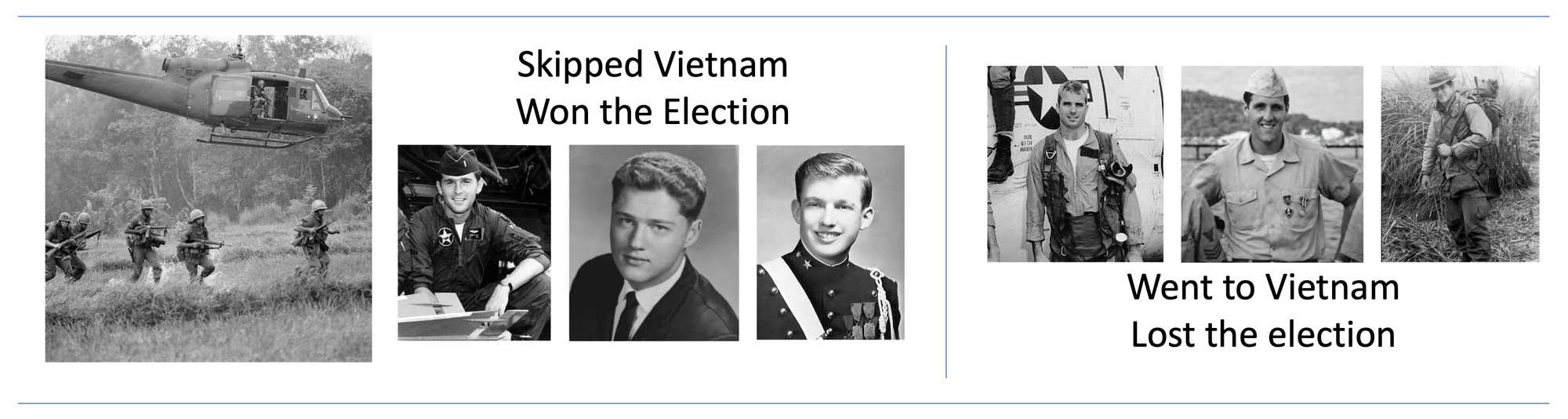
- What about George W. Bush (2000 and 2004)? It depends on who you ask. Like his father, he became a pilot, joining the Texas Air National Guard. Unlike his father, he did not fly in combat, because the Texas Guard was never called up. A spot in the Guard was highly sought after, so much so that it smells a bit, to some, of favoritism. A phone call or two from someone well connected (like a former President?) may have helped W to leap over others in line. On the other hand, he wore the uniform, demonstrating courage and skill doing what many people could never do, like pilot an F-102 fighter. And there was always the risk that his unit could be activated. As it was not, W spent his Vietnam defending Houston. Successfully.
- Al Gore (losing to Bush 2000) was one of three Presidential candidates to actually set foot in Vietnam. He enlisted after graduating college in 1969, and became an Army journalist, writing for publications like the Stars and Stripes. He was never in direct combat, though like Nixon was sometimes near it, close enough for the need to find cover. He also pulled guard duty, carried an M16, and frequently flew in helicopters over and into combat zones.
- John Kerry (losing to Bush in 2004) enlisted in the Navy and commanded a Swift Boat in Vietnam. Some people who didn’t serve directly with him somehow scraped together a few million dollars to run an ad with the fabricated claim Kerry was a coward who faked his three Purple Hearts. One might consider: 1) Kerry volunteered for his Swift Boat assignment; 2) it may be easy to fake one Purple Heart but hard to fake three; 3) that the people who served on his boat told a completely different story, praising his leadership and bravery; and 4) that anyone who served on a Swift Boat was frequently sitting in the wrong end of a shooting gallery and therefore, maybe, served honorably regardless. (I have good information on this topic. My brother served on one.)
- Barak Obama (2008 and 2012) was a kind of what? A male political ingénue, perhaps. What he wasn’t was a military veteran, the only (male) President or candidate who didn’t face a war or the draft. As he wasn’t needed, he didn’t enlist but went to college and law school instead. Bob, our Facebook commentator seems to view failure to enlist as evidence of disloyalty. A better word is, probably, normal.
- You can hardly call John McCain (losing to Obama in 2008) anything other than a real American hero. The son of an Admiral and descended from a distinguished military family, McCain was shot down over North Vietnam, captured, tortured, and when given the opportunity to leave, declined out of loyalty to his fellow POWs. After which he was tortured some more. John McCain was a great American and patriot.
- No one would dispute Mitt Romney’s (losing to Obama in 2012) patriotism, but he did have six deferments. Two years in college, then two years proselytizing the Mormon faith in France, then another two years back at BYU. So he sandwiched two extra years of deferment in the middle of his college years. I don’t personally understand how peddling the Book of Mormon in Paris should be a valid deferment, but it was the law of the land, so no complaints.
- Then Donald Trump (wins in 2016 and 2024) avoids service by virtue of bone spurs, a diagnosis made by a doctor who rented office space from Trump’s father. According to the doctor’s daughter later, her father made the diagnosis as a favor for Trump senior. What kind of favor? There could be multiple explanations. Option 1: The doctor performed a physical exam at no charge. That would, one supposes, be a favor, even for a wealthy patient who could easily afford it. And then the doctor found real bone spurs, and wrote that on his report. That would be lucky, too, if you wanted to stay out of the war. Option 2: The elder Trump asked the doctor for a favorable diagnosis that would keep Donald out of the war. “Doctor,” he might have said, “we need to keep Donald out of the military. Maybe we could help each other out?” and the good doctor complied. A false diagnosis would not be lucky. It would be a crime, one that no other Presidents or candidates committed because they ultimately faced the possibility of being drafted. On that basis, only Donald Trump can be questioned of real draft dodging, within in its legal definition.
- Finally, Joe Biden (winning in 2020, then losing in 2024), the last Vietnam era President. When he graduated from Syracuse Law School his draft board ordered him to report for a pre-induction physical exam, and he did. He failed it due to a history of asthma and was classified 1-Y, not needed today but still eligible in the event of national emergency. It is true that United States military history is filled with people so determined to serve that they found a way around a mere asthma condition. That’s admirable, but Joe Biden chose not to do so. That is not draft dodging, and he did, in fact, show up for his physical when so ordered. He took his chances and got lucky, if you call asthma luck. As with Romney, no foul.
Conclusion. Well, here we are again, at the mercy of these congenital whataboutismers who can’t be bothered to look things up. Of the three Vietnam era Presidents or candidates who didn’t serve, one was a bit slippery but even he faced the lottery, one was turned away by an Army physician for a (real) medical condition, and the third got a note from his doctor. Draw your own conclusions.
God bless these whiners, I suppose. And God Bless America for sure.
* When you wrestle with a pig, you get dirty and the pig likes it.